

I thought that this would be an appropriate follow on article to my September Mann’s article because both companies made similar products and started around the same time as James Hutchinson Mann and George Hutchinson Mann, James’s brother, was in partnership with Joseph Clayton of Clayton & Son Limited.
George Hutchinson Mann was born on 4 June 1865 and he never knew his father, William, who died on 22 May 1865 while in Canada. He returned from Canada with his mother, Elizabeth, and in 1877 when he was aged 5 he was living in Louis Street, Potternewton, Leeds, with other family members. In 1881 aged 15 he was living at 2 Eva Villas, Potternewton, and is recorded as being a mining engineer’s apprentice, unfortunately there are no other education details available.
At the age of 23 he married Fanny Tingle, at St Clement’s Parish Church, Sheepscar, on 22 January 1889. The year 1891 saw him living at 7 Studley Terrace, Potternewton, along with his wife, Fanny, and his son William aged one and he was listed as mechanical engineer draughtsman.
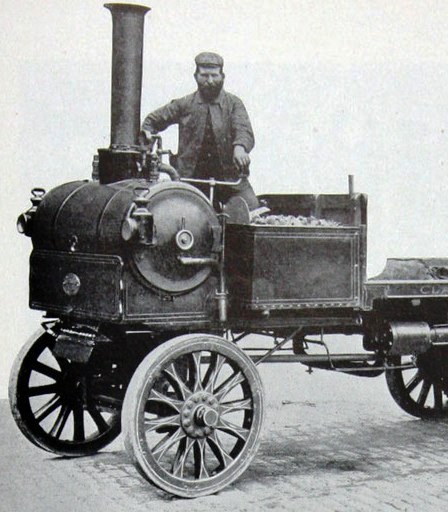
George Mann was also an inventive engineer who played a big part in the establishment of the original Mann & Charlesworth Company. In 1902 he lodged a series of patents in relation to road vehicles and the second of these patents, lodged on 29 November 1902 together with Joseph Clayton described what was to become the ‘Yorkshire Boiler’ a symbolic trade mark on all Yorkshire steam vehicles (see photo).
Joseph Clayton was born in Hunslet. His father was Lawrence Clayton a master boilermaker and one of the founders of Clayton & Son. Lawrence at this time employed 23 men and 4 boys. In 1881 the family were still living in Hunslet and Lawrence employed 102 men and 29 boys (boiler makers) in the gasometer business. By 1901 the family had moved to live in Wetherby. At Wetherby Joseph Clayton, now aged 30, is listed as a gas engineer and employer but by 1914 he is living in Leeds at Oak Hill, Park Lane, Roundhay with Fanny Louise Clayton and Marie Josephine Louise Clayton aged 9 months.
Joseph was educated at Askern College and the Yorkshire College where he attended courses on engineering and after gaining four years experience in the drawing office and as an engineer he was made a Director of Clayton, Son & Company Limited, Moor Works, Hunslet and in addition he accepted a seat on the Board of Messrs. Deighton Patent Flue and Tube Company and on the Yorkshire Steam Wagon Company becoming Managing Director of all three companies in 1912.
Patents for a double-edged locomotive type boiler that was to become a characteristic feature for all ‘Yorkshire’ wagons and the transmission to the rear axle were taken out by George Hutchinson Mann and Joseph Clayton in 1900. The first wagons built under the Yorkshire name were built in a small works in Ingham Street off Hunslet Road in 1901. In 1902 the Company was purchased by the Deighton Patent Flue and Tube Company who had been incorporated as a Limited Company in 1896. The name for the wagon Comp[any was changed to Yorkshire Patent Steam Wagon Company and with a sub-title of Branch of Deighton’s Patent Flue and Tube Company Limited.
In 1903 they moved from the Ingham Street works top a new site alongside the parent company’s works (Vulcan Works) and those of Mann’s in Pepper Road. Their first recorded vehicle made by the Company was in 1903 and was numbered 6. The first engine used was a two-cylinder compound with the cylinders mounted on each side of the chassis; the high pressure was mounted to the offside and the low pressure to the nearside. The valves were activated by a single eccentric reversing gear similar to that used by the Mann’s. Sliding gears on the crankshaft driving onto the second motion shaft were used to provide two speeds. The differential was mounted on the second motion shaft and there were gears that drove the rear wheels. An early modification was to move the differential on to the rear axle which then led to a reduction in the number of gears required in the transmission.
In 1906 a new design of engine was introduced which radically altered the wagons’ layout as the engine was now fully enclosed in a cast iron case and was mounted vertically between the frames inside the cab. Hackworth valve gear was adopted and drive to the rear axle was by roller chain. This new revised layout had the gear mounted on a crankshaft extension and this gave Yorkshire the opportunity to offer a three speed version of their wagon. In 1907 the Company entered a vehicle in the RAC Trials where they won a Gold Medal in Class F and an image of the medal was included on the transfers applied to later Yorkshire wagons.
Most of the boilers used in the production of Yorkshire wagons were supplied by Clayton, Son & Company Limited, the Directors of this Company also being Directors of Deighton’s Patent Flue and Tube Company, but there are records which show that Ruston Proctor of Lincoln produced several boilers. The original boiler had a square firebox but the boiler was subject to a programme of continual improvement and a circular firebox was introduced to reduce the number of stays required in the firebox sides and was patented in 1909.
From 1909 to 1922 the Company produced three basic models, these were the WE 3-ton, WC 4-ton, and WA 6-ton. In 1911 the company name was changed to the Yorkshire Commercial Motor Company because unlike Mann’s for a short period of time they diversified into fitting internal combustion engines in some of their vehicles. Also in 1911 the Company showed a steam tipping vehicle and the chassis for a new 25-cwt vehicle at the Royal Agricultural Show. The year 1912 saw the basic design of Yorkshire vehicles change with the introduction of the WF shaft drive wagon designed by Walter J Lewin. The engine of the WF was turned through 90-degrees so that the crankshaft was in line with the gearbox and propshaft, the Hackworth valve gear was retained but piston valves were now used.
In 1923 Lewin left Yorkshire and joined John Fowler (Leeds) Limited as Works Manager where he led the design of Fowler’s attempts to enter the steam wagon market. Lewin’s patents were held jointly with the Yorkshire Patent Steam Wagon Company and were used by Fowler’s wagon and as a result it shared many of the WF Yorkshire features including the option of a gully emptier body.
It was decided by the Directors of Deighton’s Patent Flue and Tube Company in 1922 to once again change the name of the steam wagon business because it did not emphasise the types of vehicles being manufactured and the name became the Yorkshire Patent Steam Wagon Company but still retaining the sub-title.
1926 saw the launch of the WG 6-ton double chain drive vehicle. This wagon had independent chain drive to the rear wheels, the differential was incorporated in a countershaft unit, and this was required to turn the drive through 90-degrees because the crankshaft was still mounted in line with the chassis as on the WF model. The engine was much improved; Joy valve gear was adopted and the two gears were accommodated within the cast iron crankcase, the same arrangement being used on the later shaft drive WH model and the six wheel WJ model.
The WE type remained in production until 1931 when it must have looked completely obsolete and between 1934 and 1937 the company built a number of modern diesel wagons that were fitted with engines by Gardner and Dorman in four, six, and eight wheel layouts but it is thought that fewer than 70 of these vehicles were built before the Company concentrated on the manufacture of gully emptiers and road sweepers on various commercial manufacturers chassis. In 1937 it ceased production of steam wagons with the total produced at 1,356 the last numbered 2,271.
Any further changes in name did not come until 1971 when in March of that year the name changed from Deighton’s Flue and Tube Company to Yorkshire Vehicles Limited and at some point prior to the name change the company had become a subsidiary of the Hestair Group. The company vacated the Pepper Road (Vulcan works) site in 1971 but a presence was maintained in Leeds where the maintenance of gully emptiers and road sweepers was undertaken.
Yorkshire Vehicles was dissolved in 1993 but the maintenance of specialist vehicles still continued in Leeds. Following several company changes the business was acquired by the Royal Terberg Group and is now known as Dennis Eagle and based in Warwick. The Leeds branch moved to a new site at Gildersome in March 2018.
Joseph Clayton died on 17 August 1945 when he was Chairman and Managing Director of Clayton, Son & Company.
While you’re here, can we ask a favour?
South Leeds Life is published by a not-for-profit social enterprise. We keep our costs as low as possible but we’ve been hit by increases in the print costs for our monthly newspaper which have doubled in the last two years.
Could you help support local community news by making a one off donation, or even better taking out a supporters subscription?
Donate here, or sign up for a subscription at bit.ly/SLLsubscribe
