

Thomas Richard Harding started a business in Lille, France, in 1836 making cast steel pins, combs, and other mechanical parts that were to be used in the production of textiles.
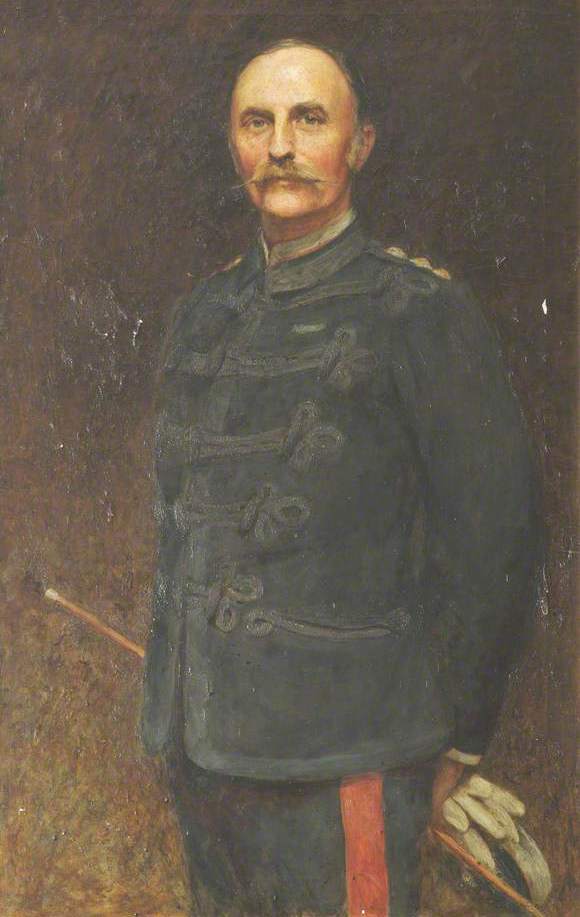
In 1853 he decided to open a factory in Leeds making the same objects that were to be used in the textile industry. While still in Lille he had a son, Thomas Walter Harding who was born on 22 January 1843. Thomas Walter was firstly educated at the Lycée in Lille, but in 1858 Thomas R and son moved to Leeds to start a new business originally in Great Wilson Street, Holbeck where by 1861 he was employing 110 hands. Thomas Walter was to continue his education at the Leeds Grammar School from 1857 but later he moved to Dresden to complete his education from 1860-1861. He is known to be living at 21 Brunswick Place, Leeds and where on his return he also joined the family firm where he eventually became its Chairman. In 1862 Thomas Walter joined the Leeds Artillery Volunteers and became its Colonel in 1879 and he used the title ‘Colonel’ thereafter.
By 1864 his trade had expanded so much that over the next two years Thomas Richard Harding was able to build the Tower Works in Globe Road, Holbeck, Between 1864 and 1866. In the 1879 census he his described as ‘hackle pin and gill maker’.
The original buildings were conveniently sited at the side of the Leeds & Liverpool Canal and designed by Thomas Shaw and featured an exotic chimney that was based on the Torre dei Lamberti Tower in Verona, Italy. In 1899 Colonel Harding employed William Bakewell to design one of the city’s most impressive land marks, a dust extraction plant tower which is a copy of Giotto’s Marble Campanile in Florence. A third plain tower was part of Harding’s final phase of expansion in 1919 and it is thought to represent a Tuscan Tower House such as can be seen in San Gimignano. All three towers have listed status. This led to the factory being called the Tower Works.
But by 1880 two other firms began making textile pins, they were William Rhodes & Company of Barrack Street, Leeds and Richardson, Child, Christy & Company, of Horsforth. In 1880 Richard Harding retired and was succeeded by his son Colonel Thomas Walter Harding and at some point in time the Company seems to have been renamed as TR Harding & Son.
Shortly after taking over at the Tower Works Thomas Walter suggested an amalgamation of the three firms and in 1892 the TW Harding business became a Limited Liability Company. The Boards of the three firms from 1892 until 1895 were identical and it is clear from the record keeping, which was all done by the same individual, that the amalgamation had taken place ‘de facto’ before Harding, Richardson, Rhodes & Company Limited came into being in 1895 and the business of Richardson, Child, Christy & Company and James Rhodes & Company were transferred to the new Company.
In 1895 TW Harding & Son amalgamated with the two other companies to become Harding, Richardson, Rhodes & Company later to become Harding, Rhodes & Company. In 1896 the Rhodes branch works were closed down and in 1897 Harding, Richardson, Rhodes & Company bought out Robert Cook & Company at Hathersage near Sheffield who had been making textile pins for about 200 years.
1900 saw the Richardson branch at Horsforth ceasing to function and there was a new factory works that employed some 500 people producing pins, cards, and combs for use with textile machinery. In 1919 the name was changed to Harding, Rhodes & Company because the Richardson family had ceased to be involved in the business.
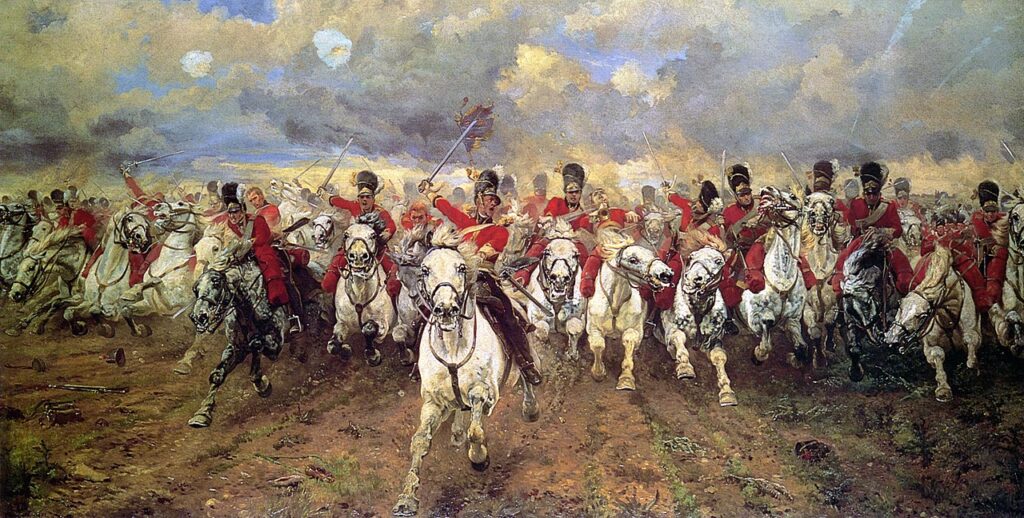
Many leading local charities were supported by Thomas Walter Harding , these included the Yorkshire College which later became the University of Leeds, He is also famous for being the first great patron of the arts in the town and he was also to play a leading part in the setting up of the Leeds Art Gallery giving it many valuable pictures including ‘Scotland Forever’, the 1881 painting of the charge of the Scots Greys at Waterloo by Lady Butler. With the help of his father he founded the Leeds Grand Theatre.
The Colonel was a High Church Anglican who politically started life as a Liberal representing the Headingley Ward on the Leeds Council. He was re-elected in 1885 but that year William Ewart Gladstone committed the Liberals to Home Rule for Ireland and Harding did not stand for re-election in 1888, probably in protest and he changed to being a Liberal Unionist.
In 1892 he was appointed the Treasurer of the Liberal Unionist Association; he was made an Alderman in 1895 and became the Lord Mayor in June 1898-1899. In the ‘Khaki Election’ of 1900 he stood as the Unionist candidate for Leeds West in which he defended the Boer War claiming that it had been forced on Britain by the folly of one Mr Kruger, unfortunately he was defeated by Herbert John Gladstone by 521 votes.
Probably Colonel Harding’s greatest contribution to the City of Leeds was for his vision of City Square for which he was the principle donor.
The Council announced a project to develop an impressive square outside the railway station and by 1893 the principle plan had been accepted. With Leeds being granted City status that year inevitably led to the proposed development being called City Square. The first step had been taken in 1889 when the Council purchased the old Coloured Cloth Hall, demolished it and replaced it with a new General Post Office building in 1895.
The main driving force behind the scheme was Colonel Harding who rather than the proposed tramway waiting room and public lavatories suggested that the square should be filled with statuary for which he would provide the financial backing. He then commissioned William Bakewell to create his bold imaginative concept.
The statues of four men who had made major contributions to the success of the City were to be placed on pedestals. Dr Walter Hook sculptured by FW Pomeroy and the Reverend Joseph Priestley sculptured by Alfred Drury were paid for by the Colonel himself. John Harrison sculptured by HC Fehr was paid for by Councillor Boston whilst Richard Wainwright paid HC Fehr for the sculpture of James Watt the pioneer of steam power. It had been intended that a statue of Ralph Thoresby would be used but Wainwright argued that it was Watt’s steam engines that that had powered the mills of industrial Leeds.
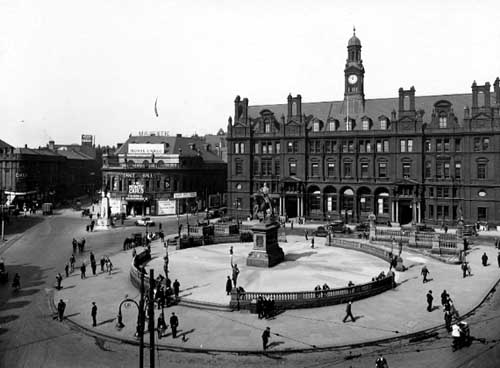
The centre piece was an equestrian bronze statue of Edward, The Black Prince, by Thomas Brook (later Sir Thomas Brook). Brook decided to have the statue cast in Belgium and after several months work the completed statue was shipped from Antwerp to Hull in a huge wooden crate measuring 18 feet by 11 feet and was delivered from Hull to Leeds by one of the Navigation’s famous ‘Fly Boats’ towed behind a steam tug. Edward was to be mounted on a plinth surrounded on the square by a circular balustrade surmounted with eight electric-torch bearing nymphs sculptured by Alfred Drury was erected.
The four nymphs standing proud and upright were called Morn; the other four resting their weary heads on their shoulders were called Even. The Square was opened on Wednesday 16 September 1903 before a vast crowd that had gathered to witness the occasion.
A War Memorial Committee was set up after the First World War and opted to place the Cenotaph in the Square and under the guidance of Harding, Fehr was again employed for the job. The Memorial was of Winged Victory hovering over Peace bearing an Olive Branch and was unveiled on 14 October 1922, but because of the increase in traffic round the Square the Monument was moved to the newly opened Headrow Garden in 1937.
Colonel Harding was created a Freeman of the City of Leeds in 1903. He moved from his home in Abbey House (originally Kirkstall Abbey’s Gatehouse) in 1901. He was appointed High Sheriff of Cambridgeshire and Huntingdonshire he moved to Madingley Hall in Cambridgeshire in 1906 which he fully restored. Colonel HW Harding died at his home in Cambridge on 26 March 1927. The company closed in 1981 after 117 years of operating on the site.
While you’re here, can we ask a favour?
South Leeds Life is published by a not-for-profit social enterprise. We keep our costs as low as possible but we’ve been hit by increases in the print costs for our monthly newspaper which have doubled in the last two years.
Could you help support local community news by making a one off donation, or even better taking out a supporters subscription?
Donate here, or sign up for a subscription at bit.ly/SLLsubscribe

A very interesting article about the Tower Works and the Hardings family, thank you for taking the time to research and write about the history of this