
I recently read Christa Ackroyd`s column in the Yorkshire Post when she and her friend Carol Vorderman deplored a recent bi-election candidate`s attack on the position of women in our society. It made me think of my life of how I and thousands of other girls and women in Leeds and the UK have been discriminated against before I began serving for 50 years as a Leeds City councillor.
It started at school. Leeds had the fewest number of grammar school places in the whole of the UK. Of those few places there were twice as many grammar school places for boys over girls. Needless to say, I did not pass the 11plus examination and went to a secondary modern school.
At school, we had mixed classes of boys and girls but we were segregated for recreational or career classes. Boys took technical drawing, and woodwork lessons. Girls took dress-making and cookery lessons. Were there not any male tailors and chefs in those days?
Apart from learning a bit of the French language, I learnt nothing that had not been taught to me at primary school!
I had always been interested in science and chemistry. When I was asked by the Headteacher what I intended to do after leaving school, I said that I should like to work in a laboratory. “Oh no dear,” he said. “You would be ideal as a secretary.”
So, at 15 years of age I went to Isles Lane secretarial college in Holbeck for a year.
Then I discovered that secretaries, in those days always women, were very subservient to male bosses, and sometimes doing their job for them! And, of course, were paid infinitely less. One of my first jobs was at a big clothing firm as a typist in a departmental office of about a dozen employees. In those days men usually had three suits – one for best, one to go to work in and the third to wear around their home. When men needed a new best suit it was “made to measure”. The job of my colleagues was to add certain of the man’s measurements together to find out how much cloth was required to make the ordered suit. Doing exactly the same job, women were paid half of what the men earned. I received an additional five shillings (25p probably now £5 or £10) a week being able to type and doing all the department’s secretarial work.
After we were married, my husband obtained a place at Oxford University and I moved down there with him for three years. I obtained a job as a secretary with the Oxford GCE Board and I joined the team of six secretaries, all women, of course. I found the work very tedious and thought that I could not do it for the rest of my life. At the time, there was a marvellous college in Oxford called Ruskin College which accepted mature students, ie over 21 years of age, who had not had the opportunity of good secondary school education. I read English and they were a very happy two years reading great literature culminating in a University Diploma.
Marvellous though Ruskin College was, I regret to say that there were 150 male students and only 10 of us women. Some local authorities paid for the students from their areas but most received financial support from their trade unions. Regrettably, Ruskin closed in 2007 because of lack of Government and local authority funding, and trade unions which were largely unable to afford to give the grants they once did when they had huge memberships.
After returning to Leeds I became involved in electioneering for a local election in 1971. I was asked if I would consider standing as a candidate the following year. It was then to the former Leeds Corporation and I had to attend an interview with senior Labour Party members to assess whether I was suitable.
I was asked which Committees I should like to serve on but was recommended Nursery and Social Services. I said I wished to serve on the Waterworks Committee which caused some astonishment as I and another women from another political party were the first women ever to be a member of the Waterworks Committee ever since its inception in the early 1800s. In fact, out of 120 councillors and aldermen (who had voting rights then), there were only 19 women!
We had to serve on two committees and my second one was the Health Committee. In those days local councils carried out many of the functions of the National Health Service. I was delegated to the then National Health Service “Family Practitioner Committee”.
I shall never forget the Committee receiving a letter from a woman employee who had reached the age of 60 and was forced to retire. She wrote an appealing letter to the Committee begging that she could continue to work as her husband was a housebound invalid and she was the breadwinner. The Committee was told that she could not continue to work as it was a Health Service rule!
As councillors were not paid then, I got some a part-time secretarial work in a small newspaper office. It was there that I realised that I could be a journalist myself and did contribute a few articles. I then obtained journalist type of work as a press officer for a big national charity and became a member of the Royal Institute of Journalists. One had to find stories which were intrinsically interesting but, in so doing, brought the charity’s name to the fore. Although I had not been happy working as a secretary in the past, shorthand and keyboard skills were then very useful.
One outrageous thing which was demeaning to women was the issuing of passports.
I did have my own passport from when I went youth hostelling in France but, after marriage, my husband and I travelled with our young son on a package holiday. My husband asked me if I wished to be included on his passport at no extra expense. I agreed thinking that if I happened to lose mine it would be a back-up. But, of course, women were not allowed to have their husband on their passports! It was the European Union which put a stop to that.
The first step towards equality began with the Suffragette movement at the beginning of the last Century for women to have the right to be able to vote. After the work women did during the First World War, the right to vote was grudgingly given to women in 1918 but they had to be 30 years old and had to have property rights. It was not until 1928 that the vote was given to all women and men over the age of 21. Since then, it has taken a hundred years for women to be treated equally in law and in practice. I hope and I ask that no political party even begins to start eroding our hard-won equality and rebuff those who try to demote it.
This post was written by Hon Alderwoman Elizabeth Nash
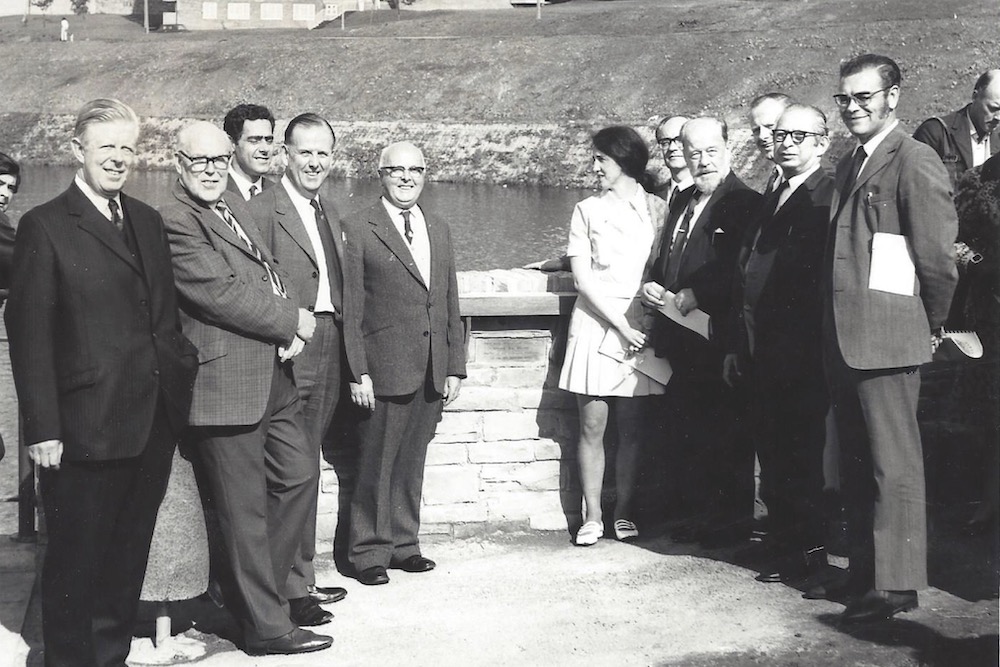
Photo: Elizabeth Nash with the Waterworks Committee visiting Farnley reservoir in September 1973
We encourage anyone living or working in South Leeds to use this website to tell their news. You can either use the Create an article for South Leeds Life page, or email us at: info@southleedslife.com
While you’re here, can we ask a favour?
South Leeds Life is published by a not-for-profit social enterprise. We keep our costs as low as possible but we’ve been hit by increases in the print costs for our monthly newspaper which have doubled in the last two years.
Could you help support local community news by making a one off donation, or even better taking out a supporters subscription?
Donate here, or sign up for a subscription at bit.ly/SLLsubscribe

Thank you, Elizabeth Nash, for this timely reminder of the restrictions posed upon women and girls’ lives, expectations and aspirations in the not-too-distant past. It strikes me that the restrictions you experienced always bore down more harshly upon working-class girls and women, and still do.
It is easy to take women’s participation in public life and work for granted, without understanding that our present rights were hard-won, and had to be campaigned for by preceding generations of women like you, and their male supporters. It is important too to acknowledge the role of the welfare state during the 50s, 60,s and 70s in providing universal healthcare, and education, including early years provision, decent housing and basic benefits, freeing working class women in particular from some of the burden of domestic work previously undertaken by them, to the benefit of men, women and children..
.
However, the welfare state and public services have been under attack since the 1970s, and every cut that makes life harder for women endangers our ability to participate fully in public life. There are even those who argue that “things have gone too far”. They don’t accept there should be equality of opportunity, are opposed to equal pay for equal work, attack abortion rights and access to contraception, and who think women’s role is, as in 1930s fascist Germany, “Kinder, Kirche, Küche” (children, church, kitchen). Unfortunately, instead of opposing the cuts and calling for taxation of the wealthy to pay for restored services, some of these dinosaurs are entering councils and government with their backward-looking ideas.
So we can’t afford to be complacent. We all – men, women and children – suffer if women’s rights are eroded. We all need to say we’re not going back, and campaign to defend and improve public services and women’s rights, as human rights.
Really interesting read especially as I did the same job as her at Peter Pell tailoring factory on Westland road working out how much material needed for each suit. It seemed the normal way of things that in a very large open plan general office all the “workers” were women and all the bosses were men I never questioned it at the time
Thank you Elizabeth Nash. This really resonates with me. I had no idea that girl’s grammar school places were at such a premium. I passed the 11 + and gained a place at Allerton High, which was at the time an all girls grammar. I also wanted to work in a lab, but was told I could be a nurse, teacher or secretary. None of these appealed and I did end up working in a laboratory for a starting wage of £4 a week. Subsequently, I got a place at Agricultural College, and was given a partial grant from LCC. Had I gone to art college, I would have been fully funded. (I still don’t understand the logic.) My future father in law was also a Leeds City Counsellor, (he coached Andrew Carter, who is still a Counsellor.)I suspect Elizabeth may have overlapped with Jack Rhodes because her name is very familiar. I have always stood up for women’s rights, and still do now.