

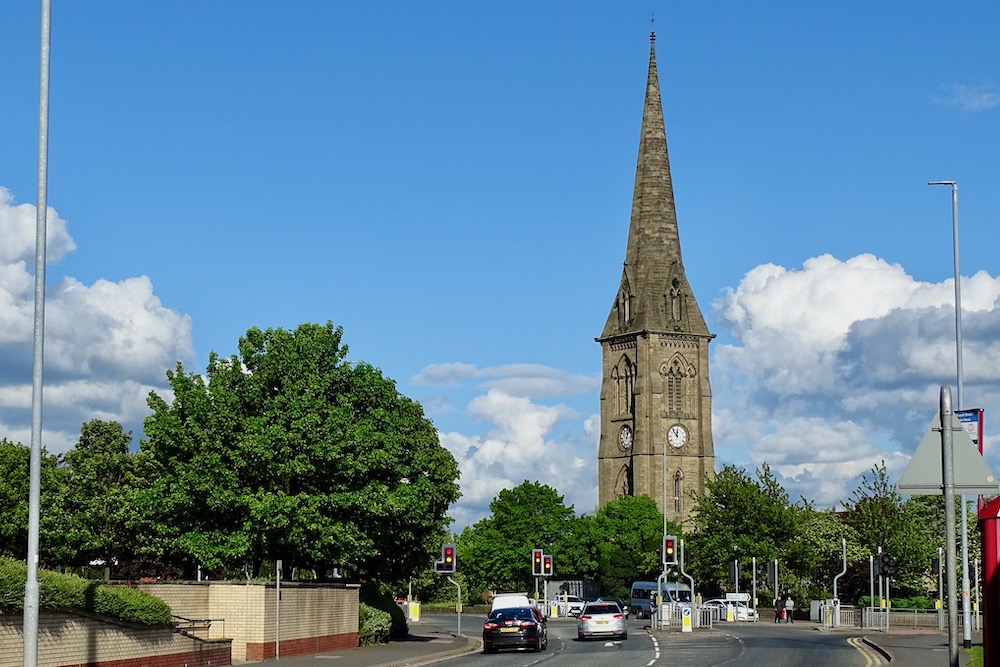
I was very pleased to see that the Hunslet Spire of former St Mary`s Church featured on the front page of South Leeds Life last month.
Its restoration has been quite a saga and it is outrageous that it has not been accessible for so many years now. Before I left the City Council four years’ ago, my colleagues Cllr Iqbal, Cllr Wray and I set aside money for the restoration of the clock for it to be automatically wound up. I hope that money is still there!
This has set me thinking about spires and steeples and the difference between the two.
Apparently, the spire is the pointed bit which stands on a tower. The whole thing, the tower and the spire together is called a steeple and perhaps that is what we should call the structure at St Mary’s?
From Norman times onwards, all churches and cathedrals were built with a tower and a spire on top. But most of the early ones had spires of wood which, over the years deteriorated and disappeared. To stop this happening, some wooden spires were covered in lead but this had its problems. The covered wood could change shape and twist. The crooked spire at Chesterfield is a famous example of this. Unlike other spires which were removed when this happened, Chesterfield kept theirs and its crooked spire is an eye-catching tourist attraction.
Spires had the religious meaning of stretching upwards towards heaven. They drew the attention of parishioners where their place of worship was situated. Usually, they contained a belltower, as did our St Mary’s, which called them to prayer.
They were also used as landmarks for travellers especially in an age before maps of our roads were available. More recently, they were used in sport eg Steeple Chasing.
The artist LS Lowry, put many spires in his paintings of mill towns. But ironically, they were always in competition with mill chimneys also stretching up to heaven. Which, one may ask, were the winners – God or Mamon? His paintings were full of little “match-stick” people going about life oblivious this.
The tallest spire in the UK is at Salisbury Cathedral at 404 feet high, followed by Norwich Cathedral at 315 feet. But the tallest spire originally was at Lincoln Cathedral which had a spire over 540 feet high but it blew down in a storm in 1540 and was not replaced. But some village churches do have some very tall spires and I came in contact with one at Hemingbrough Minster, in a village 3 miles east of Selby.
At the time I was working for a fund-raising charity as a journalist and public relations person. Fund-raising is much easier if the project has publicity. I read in the Dalesman magazine that the parishioners of Hemingbrough were struggling to raise money to repair their church spire. The church is medieval and still functioning with a pencil-slim spire 180 feet high which is an enormous height for a small church. I telephoned the vicar and he invited me to a parish committee meeting the following week.
When I arrived at the meeting I found that the repair work to the spire, although still to be paid for, had almost finished and that a new weathervane was to be installed on the top. I suggested that they invite “Blue Peter”, which was on main line television then, to install the steeple-cock. I was told in a rather dismissive way that the Committee had a rule that if anyone suggested something then that person carried it out. I agreed and wrote a letter (pre-email days) to the Editor Lewis Bronze.
Lewis Bronze telephoned me almost immediately and was delighted to send Blue Peter presenter Caron Keating to climb the scaffolding to the top of the spire to fix the weathervane. He also got the children from the local primary school involved and word spread like wildfire that Blue Peter was coming to their village. The fund-raising improved enormously and the Committee was then also able to restore some of the mullioned windows which had deteriorated, and to pay for the eradication of the death watch beetle pest.
Regarding St Mary’s spire, of course, it is not attached now to a functioning church with an active congregation. But getting young children involved with a programme like Blue Peter may galvanize the C of E to get on with the restoration work. And perhaps a steeple-cock showing the direction of wind may be as useful as a working clock if not more so?
This post was written by Hon Alderwoman Elizabeth Nash
We encourage anyone living or working in South Leeds to use this website to tell their news. You can either use the Create an article for South Leeds Life page, or email us at: info@southleedslife.com
While you’re here, can we ask a favour?
South Leeds Life is published by a not-for-profit social enterprise. We keep our costs as low as possible but we’ve been hit by increases in the print costs for our monthly newspaper which have doubled in the last two years.
Could you help support local community news by making a one off donation, or even better taking out a supporters subscription?
Donate here, or sign up for a subscription at bit.ly/SLLsubscribe

A very informative and interesting article thank you for taking the time to research this information