
We in Yorkshire are very familiar with names such as Fell, Dale, Beck and Foss. But there are other names and words which have disappeared into history.
I very recently attended an interesting talk, given by Professor Joyce Hill, on the meanings of names in Leeds and its suburbs. She explained that what is now regarded as dialect has descended from Anglo-Saxon and Viking invasions. Those, originally hostile invaders, began to settle in England and, of course, to marry local women. Their language then became in common usage.
A wiggly, diagonal line could be drawn across the map of England from the Mersey to the Thames estuary and, southeast of that line, our familiar words are incomprehensible to “southerners”. Professor Hill has very kindly helped me with place names in South Leeds.
We have Holbeck, we all know beck as being a stream, but Hol is Anglo-Saxon for deep down and the Hol Beck is indeed three or four metres below any footpath.
“Ton” comes from Old English Anglo-Saxon and originally meant a fence but then came to mean the space enclosed by the fence such as a farm. So Carlton was from the Scandinavian name of Karl and meant Karl`s Farm. Middleton is Anglo-Saxon for Middle Farm. Beeston, a farm with a particular type of rough grass. Burton, a fortified farmhouse.
Stourton, this means a farm but on the banks of the River Stour. Of course, although a common river name elsewhere, we have no river of that name in Yorkshire unless there is a local stream, or should I say beck, in the area with that name.
“Ley” is Anglo-Saxon meaning a clearing in the woods. Thus, Cottingley named after an Anglo-Saxon man called Cotta. Morley, a woodland clearing near a marsh.
“Thwaite” is Scandinavian, denoting an isolated piece of land as in Thwaite “Gate”. “Gate” is from Scandinavian “ga” – “to go” meaning a place where you go along, eg Briggate – Bridge Street; Kirkgate – Church Street. “Stall” as in Tunstall is Anglo-Saxon for place of worship.
Interestingly, where I live, Kirkstall is both Scandinavian “Kirk” and Anglo-Saxon “stall” both meaning place of worship. The monks at the Abbey must have been keen!
Knostrop, Scandinavian meaning Knut`s settlement, and “thorpe” being Scandinavian for village. “Trop” is a shortened version of “thorpe”.
Hunslet is mentioned in the Domesday Book recorded in the 12th Century as “Hunesflete” which did not always spell names correctly. It probably should have been “Fleot” the Anglo-Saxon word meaning water, river, stream and the “Hunes” a personal name.
When I was a young child, using Scandinavian or Anglo-Saxon words was regarded as “common”. For example, “To laike” – to play; “spice” – sweets. But we should be proud of our heritage speaking an older language than BBC English.
When the storms hit the south of England in 1987, Brentwood near London telephoned Leeds for help as they had heard that we had a big forestry department winning awards at agricultural shows. Leeds sent down one of its forestry teams with the lifting gear and cutting equipment and the team was welcomed like the wartime liberating armies in France!
Householders were running out of their houses asking for the road outside their property to be cleared. It was reported to me that one forester mystified a householder with:
“Eh up Love! Holt on whilst we fettle yon ginnel.”
Sadly, Leeds no longer has a forestry department but we should be proud that we still have our ancient language.
This post was written by Hon Alderwoman Elizabeth Nash
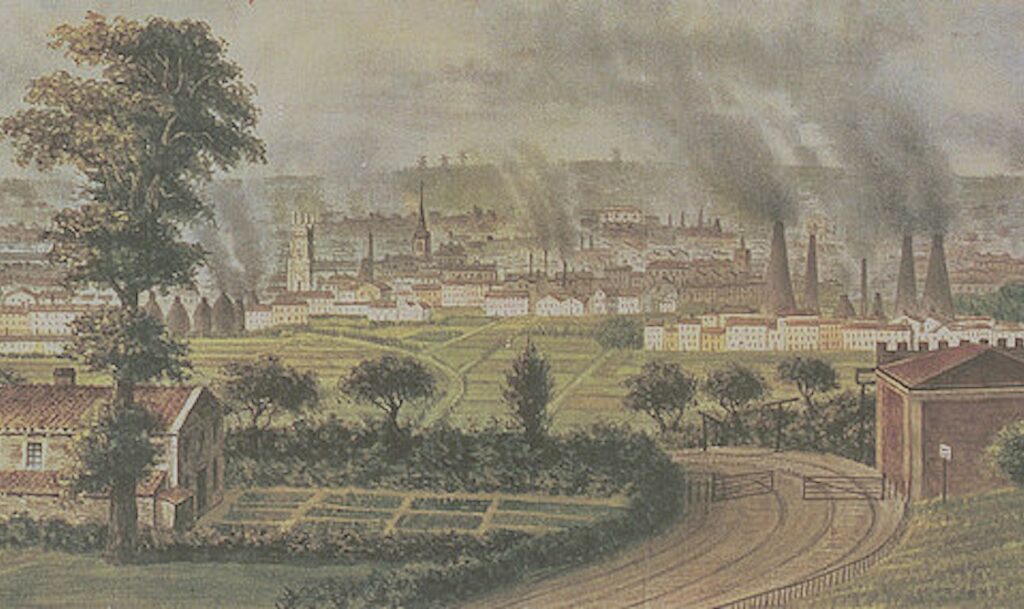
Image: Hunslet around 1827-31: Leeds from Rope Hill by Alphonse Dousseau
We encourage anyone living or working in South Leeds to use this website to tell their news. You can either use the Create an article for South Leeds Life page, or email us at: info@southleedslife.com
While you’re here, can we ask a favour?
South Leeds Life is published by a not-for-profit social enterprise. We keep our costs as low as possible but we’ve been hit by increases in the print costs for our monthly newspaper which have doubled in the last two years.
Could you help support local community news by making a one off donation, or even better taking out a supporters subscription?
Donate here, or sign up for a subscription at bit.ly/SLLsubscribe
