
 I have read many of Charles Dickens’ novels but had never read A Tale of Two Cities, despite it being the best-selling novel of all time (according to the Playhouse website, although this is often said to be Don Quixote by Miguel de Cervantes – we won’t quibble).
Whether you have read the book or not, you are likely to have heard of the opening line ‘It was the best of times, it was the worst of the times’, contrasting the chaos and order; aspiration and disheartenment of both England and France in the late 1700s.
In Paris, the revolution is unfurling and Sydney Carton and Charles Darnay both fall for the charms of Lucie Manette, setting in motion a chain of events which will endanger the lives of everyone. The story follows Lucie, her father Dr Manette, Sydney Carton and Charles Darnay as their lives become more and more involved with each other against the French Revolution running in the background.
The actors often played multiple roles and at times, I found this a little confusing. Samuel Collings as Sydney Carton and also the Marquis de St Evremonde had a very impressive and imposing sounding voice; unfortunately, this was marred at points by what seemed to be an issue with his mic or with the sound. I liked his portrayal of Sydney, a brilliant but cynical English barrister. As the play continues, we see the vulnerability and the pain that lies beneath his scornful nature.
Jordan Loughran’s performance as Lucie Manette was excellent; at times she seemed sweet and innocent but was also tough and fiery when the occasion demanded it.
Ed Sayer played Charles Darnay, a rebel child of French aristocrats, which as the revolution unfolds, places him in significant danger. This leaves those around him with difficult choices to make.
I sometimes found the dialogue was a little difficult to follow. Perhaps this may have been easier to follow if I had read the novel.
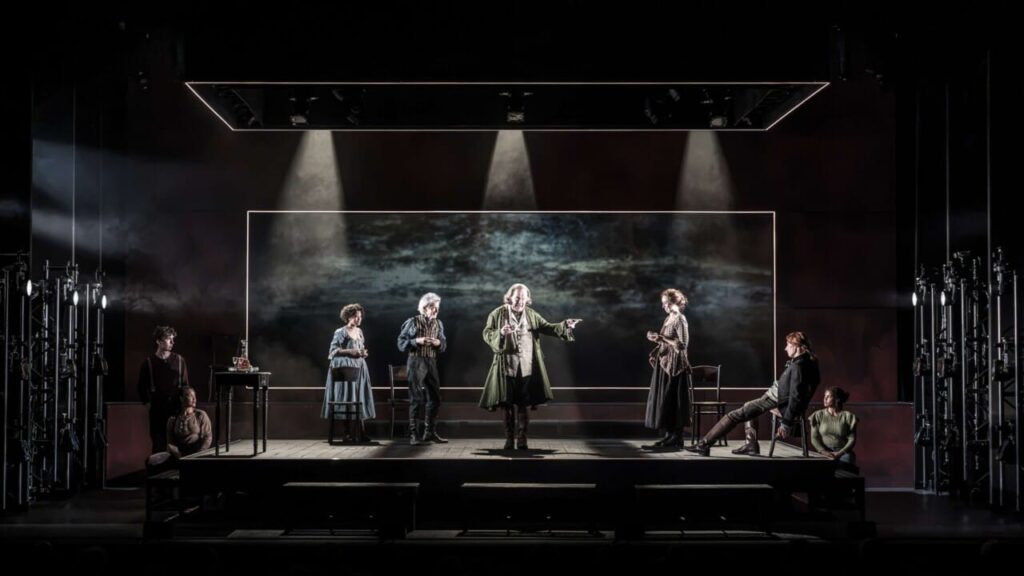
As characters who had been centre stage receded into the background, a really beautiful effect was implemented that made them seem like paintings. The set was very stark, dark and full of foreboding. It was very simplistic as a style choice, but this often made it difficult to ascertain whether the scene was taking place in London or in Paris. Some of the action on stage seemed almost balletic and this heightened the drama and increased the emotional depth.
The design of the lighting was particularly impressive in setting the mood of scenes, especially when the rest of the stage design was so minimal.
French dialogue with surtitles appeared at the top of the stage at intervals and although this was useful as an aid to understanding the narrative, it often lagged.
A Tale of Two Cities is an epic story of sacrifice, love and redemption and this production had a great cast and a provided a technical design that was admirable and effective.
A Tale of two Cities runs at the Leeds Playhouse until Saturday 26 September 2026. Full details and tickets here.
This post was written by reader Hazel Millichamp in return for two free tickets, as part of South Leeds Goes To The Playhouse.
Photo L-R: Daniel Hickey, Jasmine Kerr, Jordan Loughran, Francois Testory, Roger Ringrose, Scarlett Brookes, Samuel Collings, Robyn Sinclair. Photo credit: Marc Brenner
While you’re here, can we ask a favour?
South Leeds Life is published by a not-for-profit social enterprise. We keep our costs as low as possible but we’ve been hit by increases in the print costs for our monthly newspaper which have doubled in the last two years.
Could you help support local community news by making a one off donation, or even better taking out a supporters subscription?
Donate here, or sign up for a subscription at bit.ly/SLLsubscribe
