

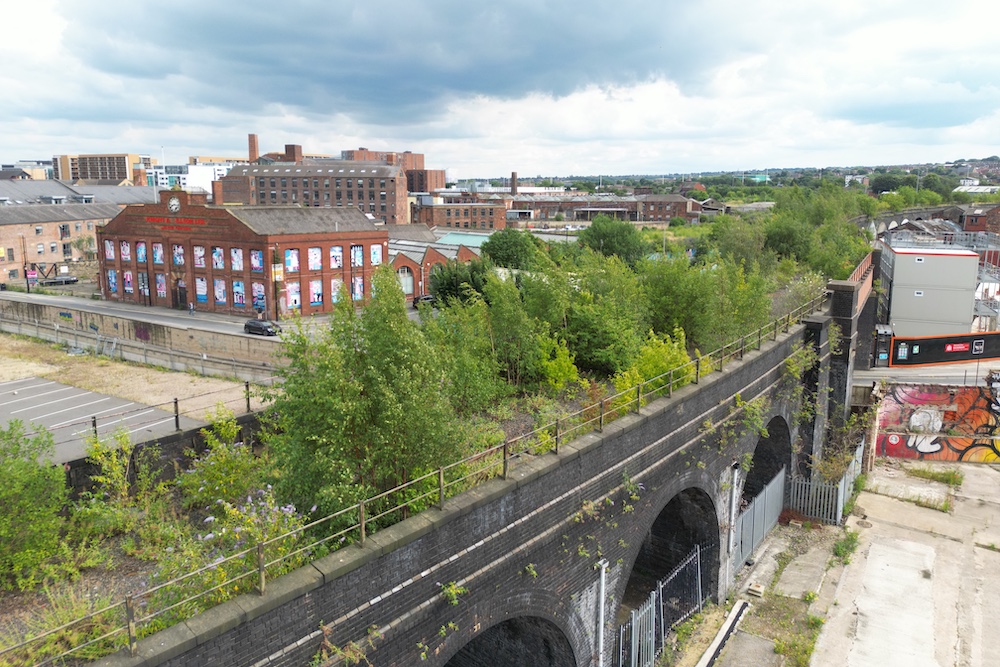
Plans to turn a derelict railway viaduct in Holbeck into a green walking and cycling route have taken a positive step forward with news that the project has secured funding to complete a full feasibility study.
The Victorian viaduct snakes its way through Holbeck from Leeds station to Wortley, but hasn’t seen a train run on it for 40 years.
The vision of the Holbeck Viaduct Project team, led by Graham Edward and Tim Reid is to create a high-level walking route between the station to Leeds United’s Elland Road stadium.
Completing the feasibility study will be a major step forward for a project we have been discussed on these pages since 2013, but now has real momentum, having recently won an international prize at the 2026 Festival of Place.
The feasibility work will lead to pre-application planning discussions with Leeds City Council. It is hoped to then submit applications for full planning permission for the section from Granary Wharf to Sweet Street, with outline permission for the remainder of the route.
Tim Reid commented:
“The Holbeck Viaduct Project CIC represents local residents, groups and businesses, providing a platform for local people to help shape the future of our city and design its shared spaces. The CIC is really excited to bring forward feasibility proposals which reimagine the Holbeck Viaduct as a new urban greenway. The team is very grateful to its funders who have been part of this journey and who share our vision for this dynamic new green corridor, connecting fragmented parts of the city.
“Leeds United Football Club, Railway Heritage Trust, Leeds Civic Trust, Leeds BID, Local Ward Councillors and a host of private donors have all helped propel the design forward for presentation to the City’s Planning Department. We are also grateful for the time provided by West Yorkshire Combined Authority, Leeds Regeneration Team and local businesses such as Countrylarge, RPG, McLaren Group and Network Rail which facilitate the project’s evolution.
“The vibrancy, safety and future prosperity of our communities rely on significant infrastructure investment of this kind. It has the power to transform south-west Leeds and make huge improvements to our daily lives.”
Graham Edward added:
“Our teams are currently working on heritage, topographical, environmental and visual surveys for Phase 1, which will help inform upcoming landscape proposals. We’ve also appointed Fieldworks to develop the project’s business model and are co-ordinating with parallel Network Rail plans to add a new approach track to City Station at the northern end of the Holbeck Viaduct.”
The project has taken inspiration from New York’s very successful ‘Highline’, but also point to the short stretch of viaduct at Wellington Place, just across the river from Holbeck, which has been turned into greenspace as a local proof of concept.
Along the route there would be a series of access points with lifts and stairs which have the potential to create business opportunities for cafes, bars and shops in the viaduct’s arches.

The walkway has been described as a linear park and will provide much needed greenspace which can be enjoyed by residents and visitors alike. Nature has already started rewilding the redundant viaduct and the plan is for planting to complement the silver birch, buddleia and valerian that has already colonised the structure, rather than replace them.
With the western end of the viaduct located on Gelderd Road near its junction with Lowfields Road, there is an opportunity to create a Wembley Way style approach to Elland Road stadium for football fans on match day. The viaduct would provide a more appealing route to the ground and relive pressure on local roads.
Progress on the project was discussed at a packed meeting last month.
Graham Edward and Joe Raper, two of the CIC’s directors, delivered a presentation on the past, present and potential future of the viaduct at Northern Monk Refectory as part of the Leeds Civic Trust’s programme of Heritage Open Days. The venue was a great choice with an elevated view of the viaduct out of the windows. There was an excellent turnout with the room full of local residents, workers and students.
Joe presented first, providing an overview of the historic development of Holbeck from the 18th century, the railway history of Leeds and the development and use of the viaduct from 1882 to its closure in 1987.
Graham followed with an update on the progress of the viaduct project, including the overarching vision, emerging design principles and the funding that has been secured for a pre-app planning submission to the City Council.
Following a formal Q&A, the attendees were invited to share their thoughts on the project, ask further questions and discuss with each other over drinks.
There was a lot of positivity in the room and there was consensus that the viaduct presents a unique opportunity to transform south-west Leeds and the lives of everyone who interacts with the area.
The Holbeck Viaduct Project CIC intend to submit pre-app proposals to the City Council in October and details of public consultation events will follow.
Fore more information and to sign up for newsletters go to: www.holbeckviaduct.org.uk
While you’re here, can we ask a favour?
South Leeds Life is published by a not-for-profit social enterprise. We keep our costs as low as possible but we’ve been hit by increases in the print costs for our monthly newspaper which have doubled in the last two years.
Could you help support local community news by making a one off donation, or even better taking out a supporters subscription?
Donate here, or sign up for a subscription at bit.ly/SLLsubscribe
